
A Registered Retirement Savings Plan (RRSP) is one of the most powerful tools available to Canadians for building long-term wealth and securing a comfortable retirement. However, life is unpredictable. Whether you are facing a sudden layoff, dealing with the rising costs of inflation, or navigating market volatility, you might find yourself eyeing your RRSP as a potential source of emergency funds.
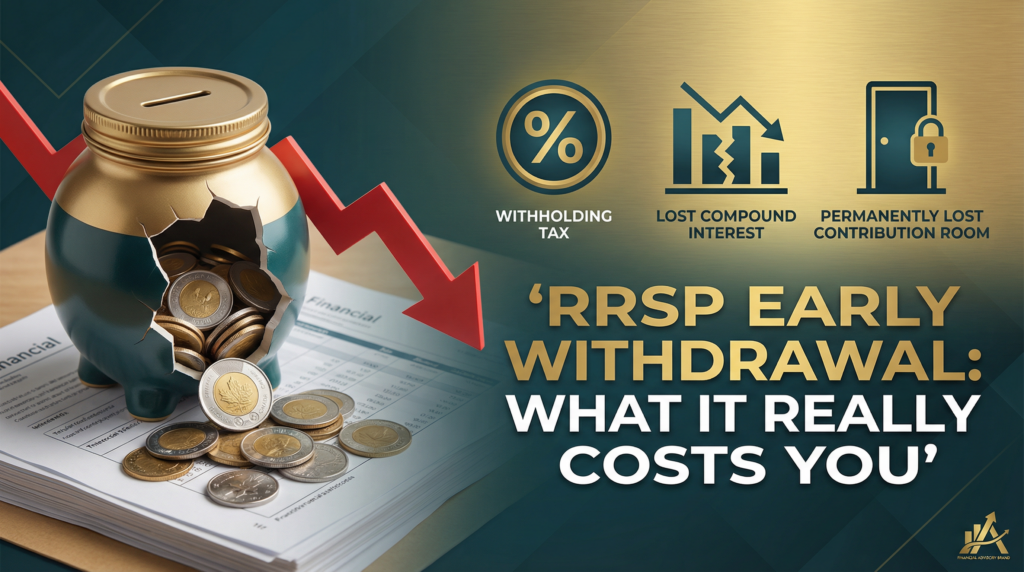
While the money is technically yours to access, withdrawing from your RRSP before retirement is rarely a good idea. Doing so triggers a cascade of financial consequences that can severely impact your long-term financial health. Let us explore the three major hidden costs of early RRSP withdrawals and what you should consider doing instead.
1. The Immediate Hit: RRSP Withholding Tax
The most immediate and visible cost of an early RRSP withdrawal is the withholding tax. When you take money out of your RRSP, your financial institution is legally required to hold back a portion of it and send it directly to the Canada Revenue Agency (CRA). This means you will not receive the full amount you requested.
The withholding tax rate depends on the amount you withdraw and your province of residence. For all provinces except Quebec, the federal withholding tax rates are as follows:
| Withdrawal Amount | Withholding Tax Rate |
|---|---|
| Up to $5,000 | 10% |
| $5,001 to $15,000 | 20% |
| More than $15,000 | 30% |
For example, if you request a $20,000 withdrawal, the institution will withhold 30% ($6,000), leaving you with only $14,000 in cash. In Quebec, provincial taxes apply in addition to the federal rates, making the immediate deduction even steeper.
Furthermore, the withholding tax is just a prepayment. The total amount you withdraw is added to your taxable income for the year. If your marginal tax rate is higher than the withholding tax rate applied, you will owe even more money to the CRA when you file your tax return. This means a $20,000 withdrawal could effectively cost you far more than the $6,000 withheld upfront.
2. The Permanent Loss: Contribution Room is Gone Forever
One of the most significant, yet often overlooked, penalties of an early RRSP withdrawal is the permanent loss of contribution room. Unlike a Tax-Free Savings Account (TFSA), where any amount you withdraw is added back to your contribution limit the following calendar year, RRSP withdrawals do not work the same way.
Once you take money out of your RRSP, that contribution room is gone forever. You cannot simply “put the money back” later when your financial situation improves. This permanent reduction in your contribution capacity directly limits the potential maximum value your RRSP can reach by the time you are ready to retire.
There is also an important consideration for those who contribute to a spousal RRSP. If you have made contributions to a spousal RRSP and your spouse withdraws funds within three years of those contributions, the attribution rules may apply. In that case, the withdrawal amount could be included in your taxable income rather than your spouse’s—potentially pushing you into a higher tax bracket. Always consult a financial advisor before making a spousal RRSP withdrawal.
3. The Long-Term Cost: Missing Out on Compound Interest
The true power of an RRSP lies in its ability to generate tax-deferred compound interest over decades. Compound interest is the process where the interest you earn on your initial investment begins to earn interest itself. Over time, this creates a snowball effect that exponentially grows your wealth.
When you withdraw funds early, you are not just taking out the principal amount—you are robbing your future self of all the potential growth that money would have generated over the next 10, 20, or 30 years. Because investments inside an RRSP grow tax-free until withdrawal, leaving the money untouched allows it to compound much faster than it would in a taxable account.
To put this in perspective, consider a $10,000 early withdrawal at age 40. At an average annual return of 6%, that $10,000 would grow to approximately $57,000 by age 65. By withdrawing early, you are not losing $10,000—you are potentially giving up over $47,000 in future retirement savings.
What to Do Instead: Smarter Alternatives for Emergency Funds
Financial experts strongly advise against using your RRSP as an emergency fund. If you find yourself in need of immediate cash, consider these alternatives first before touching your RRSP:
Tap into your TFSA: A Tax-Free Savings Account is the ideal vehicle for an emergency fund. Withdrawals are completely tax-free, they do not affect your taxable income, and you regain the contribution room the following year. Just be sure to replenish the funds when you can to keep your savings on track.
Use Non-Registered Assets: If you hold investments outside of registered accounts—such as mutual funds, stocks, or Guaranteed Investment Certificates (GICs)—consider liquidating these first. While you may trigger capital gains taxes on any realized gains, it is generally far less punitive than the immediate withholding tax and permanent loss of RRSP room.
Re-evaluate Your Budget: If you are looking for an ongoing source of cash rather than a one-time emergency sum, the best first step is to review your monthly budget. Temporarily reducing discretionary expenses can often free up the cash flow you need without jeopardizing your retirement savings. A budget calculator can help you identify where your money is going and where you can cut back.
When Is It Acceptable to Withdraw from an RRSP Early?
There are two government-approved programs that allow Canadians to withdraw from their RRSP without the standard tax consequences, provided specific conditions are met:
The Home Buyers’ Plan (HBP): First-time homebuyers can withdraw up to $35,000 from their RRSP to purchase or build a qualifying home. The withdrawn amount must be repaid to the RRSP over a 15-year period. If repayments are not made, the outstanding balance is added to taxable income each year.
The Lifelong Learning Plan (LLP): Canadians can withdraw up to $10,000 per year (to a maximum of $20,000) from their RRSP to finance full-time education or training for themselves or their spouse. Repayments must begin two years after the last withdrawal or within 10 years, whichever comes first.
Outside of these two programs, early RRSP withdrawals are almost always financially disadvantageous.
Final Thoughts
Your RRSP is designed for one specific purpose: funding your retirement. While early withdrawals might seem like a quick fix to a current financial problem, the combination of withholding taxes, lost contribution room, and sacrificed compound interest makes it an incredibly expensive choice that can have lasting consequences for your financial future.
Before making any decisions that could impact your long-term financial security, it is always best to consult with a professional financial advisor. At Safe Haven Financial, our advisors can help you navigate financial emergencies, optimize your savings strategy, and ensure your retirement goals remain on track—without compromising the nest egg you have worked so hard to build.
Need help managing your RRSP or retirement strategy? Contact Safe Haven Financial today for a personalized, no-obligation consultation.